LRB 0220 -
A measure that would provide $5.6 million for water infrastructure projects potentially finishing all high and medium priority projects identified by the DNR.
There is important legislation working its way through state government that is vital for State Parks. Senator Cowles, Rep Kitchens and Rep Tusler are sponsoring a measure that would provide $5.6 million for water infrastructure projects potentially finishing all high and medium priority projects identified by the DNR. These include drinking water, water lines, septic, and shower facilities. This is critically important in this era of under-funding state lands.
Friends of Wisconsin State Parks support LRB 0220 and we are asking Friends Group to contact their legislators to ask them to become bill co-sponsors and support this measure. Below are talking points that can be used to discuss this with your legislator.
Anyone who visits a property in the Wisconsin State Park System knows that these are truly special places. But despite the enjoyment from some of our state’s best opportunities for outdoor recreation, dilapidated infrastructure can create a lasting impression of our State Park System that can be hard to break. Unfortunately, with hundreds, if not thousands of backlogged infrastructure projects, there’s far too many opportunities for these impressions to be made.
While many backlogged infrastructure projects in the State Park System are less urgent, other rundown infrastructure, often decades old, can cause concern for human health and water quality. Building on the efforts from recent sessions, LRB 0220/1 provides $5.6 million in authorized but unobligated Stewardship bonding authority from the most recent fiscal year to complete necessary health and safety water infrastructure upgrades in our State Parks System.
The projects completed from this bill are at the highest risk of failure. These properties include Governor Dodge, Mirror Lake, Nelson Dewey, New Glarus Woods, Rib Mountain, Wyalusing, Hartman Creek, Merrick, Newport, Perrot, Potawatomi, Rocky Arbor, Willow River State Park, Governor Earl Peshtigo River, Kettle Moraine State Forests, Kinnickinnic, Kohler-Andrae, Lake Wissota, Mill Bluff, Potawatomi, Rib Mountain, Rocky Arbor, Tower Hill, Brule River, Governor Knowles, Peshtigo River, Northern Highland-American Legion State Forests, Cadiz Springs, MacKenzie Center and others.
Most visitors will never notice that the water infrastructure is up-to-date. But if those fixtures are run down or out-of-service, it may impact the visitor’s experience in our State Parks and may impact their plans to come back or visit other State Parks in the future. Further, an isolated illness or outbreak of water-related disease at our State Parks would not only be devastating to those impacted and their loved ones, but could cause ripple effects and harm our entire outdoors-based tourism industry.
The upgrades in LRB 0220/1 have the potential to make positive and needed improvements at 36 properties across 30 counties. These upgrades will benefit the residents and tourists who contributed to 20 million visits to State Park System properties in 2020 and will help to ensure that number continues to grow.

Thursday, October 7, 2021

Friday, June 11, 2021
JOINT FINANCE COMMITTEE RECOMMENDS INCREASING FRIEND GROUP STEWARDSHIP GRANTS
JOINT FINANCE COMMITTEE RECOMMENDS INCREASING FRIEND GROUP STEWARDSHIP GRANTS
Many FWSP Board Members and Friend Group leaders have been engaged in this legislative season. Governor Tony Evers released his budget in April while the powerful Joint Finance Committee (JFC) hopes to complete their budget later this month. One of FWSP’s legislative priorities is increasing the Stewardship Friends Groups Grants. The “Friends” message is coming across loud and clear as both Governor Evers and the JFC are recommending huge increases. Governor Evers recommended the grant program is expanded from $250k to $1M, while the JFC raises it to $500K. This is wonderful news for the many Friends Groups who rely on these monies for projects. The state budget still has to go through a reconciliation process and will be sent to Governor Evers later this summer. Friends to
Friends will keep you posted on this and other legislative priorities. Until the budget is done, it’s never too late to contact your legislator. Visit FWSP.org and click on legislative priorities for more information.
A special thanks to everyone who contacted their legislator including FWSP Board Members Jerry Leiterman and Randy Paske, Friends of Hartman Creek Alice Williams, Friends of Bigfoot Beach Chris and John Ecklund, Friends of Peninsula Chris Holicek and Steve Strucely, and Friends of the Hank Aaron Trail Dan Adams.
Michael McFadzen
Monday, May 24, 2021
2021-22 Legislative Priorities

Friends of Wisconsin State Parks (FWSP) is a 501c3 organization that represents Friends Groups and WI residents that use state lands. There are approximately 87 Friends Groups that support various state park, trails, recreation areas, and forest properties. These local Friends Groups provide thousands of volunteer hours and have delivered over $100M dollars to help support state lands infrastructure and programs.
There has been a gradual deterioration of infrastructure and operations since general-purpose revenue was cut in 2016. The State is underfunding state lands. State Park's maintenance backlog and necessary infrastructure improvements are estimated to be close to $1B. Wisconsin is one of the only state park programs in the country attempting to run park operations on a fee-based system. Fees are increasing and not all people can afford it. The State should be obligated to maintain and invest in state lands for current and future generations.
Parks are one of the best ideas our forefathers had. Putting away some of the state’s finest areas for everyone to enjoy is imperative. Parks are not simply a commodity that can be managed through funds raised by fees and then cut to balance budgets. That approach ignores planning and stewardship of this important resource.
The impact of state parks on local economies and tourism is enormous. Local businesses rely on state park visitors to sustain their businesses.
Comparing Wisconsin to other Park systems
Using diversified revenue streams, Minnesota funds its system at $70M annually. Approximately $24M comes from the State’s General Fund, $19M from user fees, $6M from lottery revenue, and $18M from Legacy Park and Trails Fund. In 2008, Minnesota passed a constitutional amendment that dedicates a portion of sales tax for outdoor recreation. Parks have received over $350M in Legacy funding thus far.
Michigan’s state parks also have several revenue streams. These include a $500M endowment fund, oil and gas revenues, user fees, general fund, and recreation passport. Michigan annual funding is estimated at over $60M annually.
In contrast, Wisconsin has no legacy fund, endowment fund, or lottery revenue. Over the last ten years, park operation costs are reported in the $17-19M range which represents fees collected from visitors (Infrastructure improvements often use Stewardship funding) Up until 1995, Wisconsin parks were funded equally from tax-payer GPR (general purpose revenue) and fees. Since then, tax-payer support has been slowly whittled away.
Legislative Priorities
- Increase spending authority for Parks. The legislature controls how much revenue parks can spend from the Segregated Parks Fund. The legislature required parks to be operated as a business. Parks have increasing revenue due to collect fees but can’t invest it back due to legislative control. It would be valuable for Parks to have this flexibility. This would allow Parks to hire more naturalists and educators to engage visitors and drive additional revenue. The Joint Finance Committee allowed some funding through the Parks Segregated Fund in the last budget.
- FWSP recommends increasing electrical campsites from 35% to 50% to meet public demand. Current statutes limit how many campsites have electrical access. After the initial capital outlay, this generates additional revenue due to increased demand for this type of camping experience.
- FWSP supports the reauthorization of stewardship above current levels and the segregated component that funds Friends Groups projects. Governor Evers proposed increasing this component from $250,000 to $1M annually. These are matched 50% by Friends Group monies which doubles investment in state properties. Unlike most snowmobile and ATV aid programs which are not user matched.
- FWSP supports 4th Grade State Parks Admission. Governor’s Budget includes a gratis annual state parks admission sticker for families of 4th graders. This component has minimal DNR cost and it engages future generations to natural resources.
Long-Term Legislative Priorities Provide Solutions to Park Funding
- Work with DNR and the legislature to develop sponsorship opportunities. This would allow DNR to identify donors by signage or other means for projects such as pavilions, visitor centers, trail and other infrastructure projects. The UW System and Tourism already do this. It would be helpful to allow Parks to solicit donations similar to other agencies. Current capital deferred projects are estimated to be close to $1B. Currently, Friends Groups are fundraising over $60M for projects. This would be supportive to Friends Groups at Willow River, Lakeshore, Devils Lake, and other state parks which are involved in large capital projects.
- Explore additional and sustainable funding sources for State Parks. These include tax initiatives and gaming proceeds for funding capital development projects and operational costs. Endowments and other types of legacy funding are common in many other state park systems.
- The DNR should maintain responsibility for the planning of co-managed state trials. The current agreements allow planning to be the responsibility of county partners which have caused trail use to “flip” based on local situations. This is untenable for Friends Groups who have made a long-term commitment to these state properties and for the long-term stability of the state trail system.
Tuesday, February 16, 2021
FWSP 2021 LEGISLATIVE INITIATIVES

The legislative season for FWSP has started, coinciding with the 2022-21 State Budget. Budget hearings were held virtually in late 2020/early 2021 by the Executive branch. The Joint Finance Committee (JFC) is holding in-person hearings across the state. Policy Committee submitted FWSP legislative priorities to the JFC. The proposed budget includes a big raise for Stewardship but is unlikely to pass the legislature in the current form. There is an increase in Friends Group Grants from $250K to $1M in the proposed budget.
The Policy Committee will focus on educating members of the Joint Finance Committee and other key legislators on state land needs.
The Policy Committee will release a position paper with key priorities/talking points during the budget process. This will be promoted via different methods. We will be asking FWSP Board members and Friends Groups to contact their legislators.
FWSP 2021-22 LEGISLATIVE PRIORITIES-SHORT TERM
- Increase or eliminate spending authority for Parks. The legislature controls how much revenue parks can spend from the Segregated Parks Fund. Most states don’t have this restriction. Parks have increasing revenue but can’t spend it due to legislative control. It would be valuable for Parks to have this flexibility. This may allow Parks to hire more naturalists and educators to enhance visitor experiences.
- FWSP recommends increasing electrical campsites from 35% to 50% to meet public demand. Current statutes limit how many campsites have electrical access. No park can have more than half of its sites electrical and no more than 35% of the entire state park campsite inventory can be electrified.
- FWSP supports re-authorization of the Knowles Nelson Stewardship Program at or above current levels including Friends Group Grant Increase to $1M annually
- Support 4th Grade State Parks Admission. Governor’s Budget includes a gratis annual state parks admission sticker for families of 4th graders.
LEGISLATIVE PRIORITIES-LONG TERM
- Work with DNR and the legislature to develop sponsorship opportunities. This would allow DNR to identify donors by signage or other means for projects such as pavilions, visitor centers, trail and other infrastructure projects. Current capital deferred projects are estimated to be close to $1B. This item is much larger than Parks and would likely include all of the DNR. The UW system and Tourism already do this. It would be helpful to allow Parks to solicit donations similar to other agencies. Currently, Friends Groups are fundraising over $60M for projects. It would be supportive to network with Willow River, Lakeshore, and Devils Lake Friends Groups who are planning large capital projects
- The DNR should maintain responsibility for planning of department owned linear trails. The current agreements allow planning to be the responsibility of the local cooperator which has caused trail use to “flip” based on local situations. This is an untenable situation for local Friends Groups who have made a long term commitment to these state properties and for the long term stability of state trail system.
- Explore additional and sustainable funding sources for State Parks. These include tax initiatives and gaming proceeds for funding of capital development projects and operations. Endowments and other types of legacy funding are common in other state park systems.
If Stewardship is not passed, it might be necessary to close specific properties due to water, septic, and other infrastructure needs.
Saturday, February 8, 2020
Water, Infrastructure, and Ticks
 |
| Mike McFadzen |
There will be a huge boost for water facility and other infrastructure projects as the Parks Revitalization Act was signed into law by Governor Evers in February. The bill provides $5.2M for critical health and safety-related water projects in state parks. This bill is the second component of Senator Rob Cowles (R- Green Bay) sponsored bills that provides approx. $10M for state parks water infrastructure projects. Ticks are on the move which is causing an increasingly severe public health threat. Wisconsin Governor Evers recently signed four bills into law which will help protect state lands visitors.
Act 73 requires tick awareness signage on state lands where ticks are present. Act 74 requires tick repellant be available for sale at numerous state lands; including many local Friends Group stores.
Two other bills are also expected to pass, including a Lymes Disease (LD) awareness program and the establishment of a LD Task Force.
A measure to fund a LD Epidemiologist will likely not pass. These measures are a realistic start as Wisconsin has been lagging other states in LD legislation even though Wisconsin is the 4th worst state in the country for Lymes Disease.
Ever since General Purpose Revenue (GPR) was cut from State Parks in 2017, FWSP has worked hard to find a sustainable funding source for state lands. Resumption of GPR or other funding source is critical to help with an estimated $400M backlog of infrastructure repair and necessary building projects. Wisconsin is one of the only states in the country that relies solely on user fees to fund its state parks operation. Contact Policy Chairman Michael McFadzen if you can help in these efforts.
Watch Video here
Michael McFadzen has been involved in recreational and natural resource issues for over 20 years. Currently, Michael is the FWSP Policy chairperson which follows legislative and other issues that affect state parks, trails, and other state properties.Watch Video here
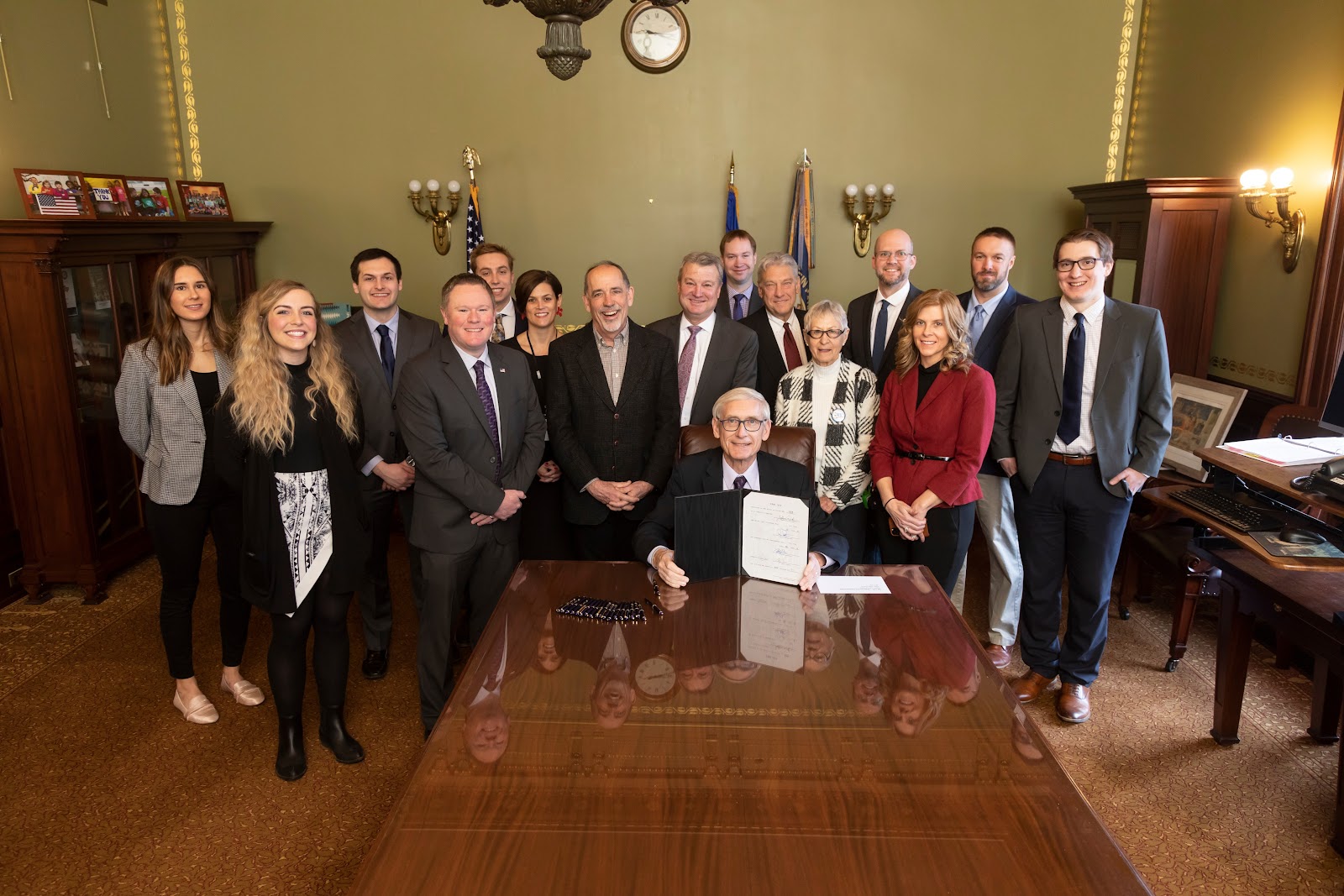 |
| Michael McFadzen, FWSP Policy chairperson, (Governor Earl immediate right) |
Thursday, December 13, 2018
Governor Elect Evers,

The Friends of Wisconsin State Parks (FWSP) is a non-profit organization that has existed for over 20 years with a mission to preserve, promote, protect, and enhance the Wisconsin State Parks, Trails, and Forests. While our direct work is with state park leadership, we represent and support over 80 individual state park, forest, trails, and recreation areas friends groups throughout the State of Wisconsin.
Collectively, these 80 plus organizations represent thousands of volunteers and partners that work alongside the Wisconsin DNR's State Park Program to ensure the parks, trails, and forests continue to be the premier destination for millions of people each year. Our support to local groups comes through advocacy and educational materials, communication and promotion, grants, and other donations made by FWSP to local friends groups.
The past few years has been both challenging and rewarding for FWSP as we have worked through the many changes in the WDNR and the WI State Parks Program. Through this, we have become a fully independent organization that has a very close working relationship with the WDNR as well as the State Legislature.
FWSP has asked many questions regarding operating costs and funding since the 2015-2017 state budget made the WI State Parks a self-funded program and removed all tax money support. In fact, we did not support this model originally but have since worked closely with the parks program to create an operationally self-funded model that is working well and we now support. This model allows for any additional outside money that comes into the State Parks program along with Stewardship Funds to be used for much-needed repairs and replacement of extremely old infrastructure throughout the parks.
One of our most noteworthy accomplishments over the past few years was our work in helping make over 8 million additional dollars available to the State Parks program. This included increasing the spending authority on the user-fee funded park segregated account and increase the amount of stewardship money available for critical infrastructure repairs and replacement throughout the state. FWSP worked directly with the millions of park users and elected officials to educate and raise awareness of these issues which ultimately resulted in several different legislative packages to enhance and repair our state parks to ensure the outstanding experience Wisconsin State Park visitors expect.
FWSP, along with the local friends groups, have been watching the DNR's alignment very closely since 2016. We were appreciative that program leadership met with us early in the process to discuss all the changes. The most significant change we were somewhat skeptical of was the changes made that took law enforcement credentials away from park and forest rangers. However, we were reassured the DNR's plan to have game wardens performing the work would only change the "color of the shirt" of the person doing the work and that visitors to parks, forests, and trails would not see any negative changes. During the summer of 2018 FWSP became aware of several problems associated with the law enforcement alignment. We were hearing about these issues directly from park users, volunteers, campground hosts, our local friends members, and reading articles in the Wisconsin Outdoor News. What we were hearing from those in the parks and forests was that visible law enforcement in the parks was all but gone in the mid-size and smaller properties. From our camping constituents at all properties, we were hearing of complaints of lack of LE presence in the campgrounds and lack of response to handle loud, intoxicated, or otherwise bothersome campers. Campground hosts are getting uncomfortable with the lack of law enforcement availability to handle issues within the campgrounds. Additionally, an article in the Outdoor News stated that the new warden model was going to cost the parks program millions more than using credentialed rangers had in the past. Therefore, hearing what we were, during the summer of 2018 we wrote a letter to DNR leadership regarding our concerns. We were pleased when shortly after we reached out to the DNR they announced they would be re-credentialing Rangers back in the Parks and Forests to ensure the financial sustainability of the parks account and to ensure all DNR customers were getting the service they deserve here in a state with a rich history in both hunting and fishing enforcement as well as park and forest enforcement. We were proud of the DNR for acknowledging that the replacement of law enforcement rangers with game wardens was not sustainable or practicable.
As we approach 2019 we are already thinking about the busy season coming up in our parks next summer. Many of us are year-round users or volunteers at our parks, forests, and trails. We understand that things take time to implement, but we are starting to notice an uneasiness from our constituents across the state as 2019 approaches and the lack of visible action by the DNR to implement putting credentialed rangers back into the parks and forests. We are proud to be part of the state park tradition here in Wisconsin. We are also proud of the fact that we were able to work with the DNR to make the self-funded model the program has been operating under since 2015 a success. In fact, as I talk to other friends groups around the country, we are one of the only states to be successful at this as many have failed. We will not support any initiatives that cost the parks program additional money and results in less service to the user paying the fees. FWSP believes it is imperative to return credentialed rangers back to our parks and forests for the safety and comfort our Wisconsin State Park users have come to expect and demand to keep the parks the envy of the nation.
FWSP values the relationship we have with the current DNR leadership team and look forward to meeting with the new DNR leadership shortly after the first of the year to discuss our concerns.
Respectfully,
Bill Zager
Pres. of Friends of Wisconsin State Parks
CC: Secretary Meyer
Sen.Cowles
Sen.Marklein
Sen.Erpenbach
Sen.Schachtner
Rep.Tusler
Rep.Kitchens
Sanjay Olson
Erin Crain
Benjamin Bergie
Patricia Loosen
FWSP Executive Board
Respectfully,
Bill Zager
Pres. of Friends of Wisconsin State Parks
CC: Secretary Meyer
Sen.Cowles
Sen.Marklein
Sen.Erpenbach
Sen.Schachtner
Rep.Tusler
Rep.Kitchens
Sanjay Olson
Erin Crain
Benjamin Bergie
Patricia Loosen
FWSP Executive Board
Sunday, January 21, 2018
State Park Funding
 Many of us have been hearing about state park funding and have questions about how it will affect our parks and trails. Local friends groups provide thousands of volunteer hours and have delivered approximately $100M dollars to help support the mission and activities of the Wisconsin state parks, forests, trails, and recreation areas.
Wednesday, January 17, 2018
2017 Legislator of the Year Award to Representative Ron Tusler (R- Harrison)

The Legislator of the Year Award is given annually to a Wisconsin legislator and staff who best champions the advancement of Wl Parks and related natural resource issues. This recognition is for leadership in promoting
Tuesday, October 3, 2017
Legislative Action/Networking
FRIENDS OF WISCONSIN STATE PARKS (FWSP)
Legislative Action/Networking
Networking with Friends Groups is one of the most important strategic initiatives FWSP has. Healthy, growing and dynamic chapters are critical to the success of park and trail properties.FWSP started the networking process by assigning one or more chapters to each board member. Board members will discuss
Monday, October 2, 2017
Hunting and Trapping in Parks and Trails
Hunting and Trapping in Parks and Trails- The Wisconsin Legislature passed and Governor Walker signed into law ACT 168, the Hunting Heritage Bill. A bizarre last-minute amendment included opening all State parks and trails to hunting & trapping. The legislature handed off the rulemaking to the DNR’S Natural Resources Board (NRB). The NRB did the
Sunday, October 1, 2017
GPR Funding
Friends of WI State Parks (FWSP) is a 501c3 organization that represents WI residents that use parks and trails. There are approximately 80 Friends Groups that support various state parks, trails, and forest properties. These local Friends Groups provide thousands of volunteer hours and have delivered approximately $100M dollars to help support the mission
Wednesday, September 6, 2017
Recreation Opportunities Analysis (ROA)
Dear Friends Groups-
The DNR is embarking on a study, known as the Recreation Opportunities Analysis (ROA), to review existing outdoor-based recreation opportunities and future recreation needs.http://dnr.wi.gov/topic/Lands/RecAnalysis/ This is an excellent occasion to engage DNR leadership and have an impact on parks and trails. Some of the goals are:
- ensure that DNR resources are
Tuesday, September 5, 2017
Monday, September 4, 2017
State Budget: GPR Not Restored But State Budget Success for Parks
State Budget: GPR Not Restored But State Budget Success for Parks
FWSP and other natural resources organizations were very active during the budget debates. It appears that General Purpose Revenue (GPR) will not be restored for state parks in this budget cycle. While there is widespread public support for restoring GPR, there were not enough legislators
Sunday, September 3, 2017
Friends of Wisconsin State Parks Members joined Gov. Walker as the Water Infrastructure For State Parks Was Signed into Law
J

MADISON– Senator Robert Cowles (R-Green Bay) and Representative Ron Tusler (R-Harrison) released the following statements as the Parks Revitalization Act, was signed into law as 2017 Act 71:
Senator Cowles stated, “The Parks Revitalization Act is designed to tackle the ongoing issue of degrading water infrastructure in some of our most visited parks. Good drinking
Saturday, September 2, 2017
FWSP is opposed to co-opting NR 44
The Friends of WI State Parks (FWSP) is a 501c3 organization that represents WI residents that use state properties. There are approximately 80 Friends Groups that support various state parks, trails, and forest properties. These local Friends Groups provide thousands of volunteer hours and have delivered approximately $100M dollars to help support the mission and
Friday, September 1, 2017
MEETING WITH LEGISLATORS and POLICY MAKERS
MEETING WITH LEGISLATORS and POLICYMAKERS
For many people, this will be the first time meeting with your legislator. Call or email beforehand to schedule the meeting and describe the topic/issues you want to discuss. An aide will take notes and ask what you are interested in. Many legislators will meet with their constituents in
GPR Resumption Document
The Friends of WI State Parks (FWSP) is a 501c3 organization that represents WI residents that use parks and trails. There are approximately 80 Friends Groups that support state parks, trails, and forest properties; including the Friends of the Kettle Moraine and Friends of Kohler Andre.
Wednesday, December 7, 2016
DNR Alignment
December 7, 2016
Dear Friends of Wisconsin State Parks-
Many of us have been hearing about the DNR alignment and have questions about how it will affect our parks and trails. Local friends groups provide thousands of volunteer hours and dollars to help support the mission and activities of the Wisconsin state parks, forests, trails, and recreation areas.
Wednesday, November 16, 2016
Northern Forest Act 358 Master Plan Variance
November 16, 2016
RE: Northern Forest Act 358 Master Plan Variance
This letter is in regards to Master Plan Variance, Act 358, to increase logging in northern WI State Forests.
The Friends of Wisconsin State Parks (FWSP) is a §501(c)(3) not for profit statewide organization whose mission is directed at the care, preservation and protection of Wisconsin State Parks, trails and natural resources related to those properties.
Subscribe to:
Posts (Atom)